The street
Boulevard Poissonnière and the Grands Boulevards: a short history
From city walls to promenades to theatres: the stretch of Paris where the show is staged.
Reserve your seat ↗Quick answer
Boulevard Poissonnière is a 351-metre stretch of the Grands Boulevards, formed in 1676 on the ring that replaced Paris's old walls. It sits on the border of the 2nd and 9th arrondissements, between Boulevard de Bonne-Nouvelle and Boulevard Montmartre, and it has hosted a café-concert, early cinemas and, since 1921, the Théâtre des Nouveautés.
From ramparts to boulevards
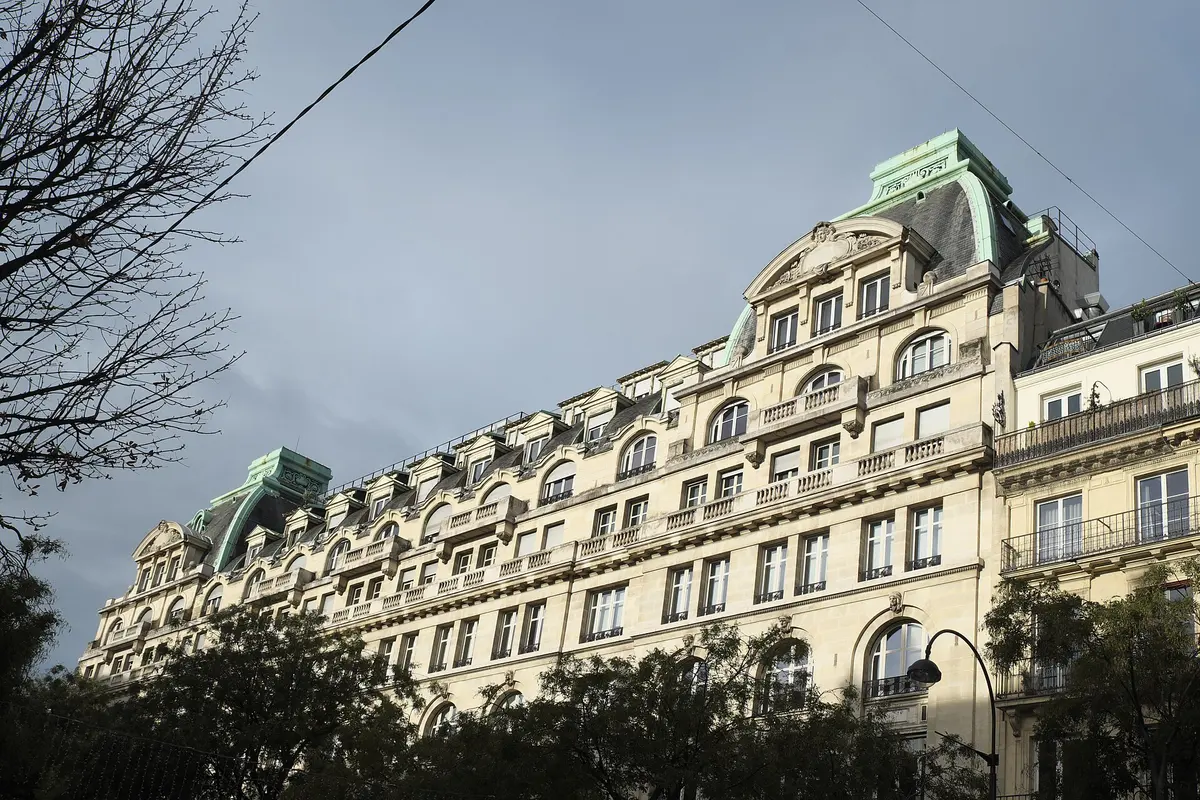
English Wikipedia says the Grands Boulevards began with a late-1660s plan under Louis XIV's minister Jean-Baptiste Colbert to reform Paris. Its central idea was to replace the demilitarised city walls with a ring of boulevards, starting in 1670. Strictly defined, the Grands Boulevards follow the former walls of Charles V and Louis XIII on the right bank. The article lists eleven of them in order, from Boulevard Beaumarchais to Boulevard de la Madeleine, and Boulevard Poissonnière is seventh. A wall that once kept people out had become a place for them to stroll.
The name and the numbers
French Wikipedia says the boulevard takes its name from the nearby rue Poissonnière, itself part of the chemin des Poissonniers, the route by which fish travelled from the northern French coast to the central markets of Les Halles. It was formed by letters patent in July 1676, and a royal ordinance of 4 May 1826 set its width at 35 metres. It runs 351 metres on the border of the 2nd and 9th arrondissements, from Boulevard de Bonne-Nouvelle to Boulevard Montmartre. The same page says the boulevard is served by the Grands Boulevards and Bonne-Nouvelle stations.
A street of cafés and screens
The same French article lists what stood here. Le Brébant, a café-restaurant at number 32, was founded in 1865. Parisiana, at number 27, opened in 1894 as a café-concert, later became a cinema and closed in 1987. At number 7, Léon Gaumont's first cinema hall, the Gaumont-Théâtre, opened in 1908 and closed in 1977. Midi-Minuit, at number 14, opened as a cinema in 1939 and closed in 1985. A boulevard that began as a promenade became, in turn, a place of food, song and film, which is another way of saying it was built for entertainment from early on.
Le Grand Rex at number 1
English Wikipedia says Le Grand Rex opened on 8 December 1932, designed by Auguste Bluysen and the engineer John Eberson, with Maurice Dufrêne decorating the great hall. The film producer Jacques Haïk is credited with conceiving it. The main auditorium holds 2,702, according to the infobox, and the facades, roofs, hall and decor have been a monument historique since 5 October 1981. Today it also functions as a concert and show venue. French Wikipedia adds six smaller screens, seating from 100 to 500, beside the main hall.
The Théâtre des Nouveautés at number 24
French Wikipedia says the boulevard's number 24 was built in 1921, alongside the Max Linder Panorama cinema. The theatre was inaugurated on 21 April 1921 with La Journée des surprises, by Jean Bouchor, under Benoît-Léon Deutsch with Gilbert Dupé. Its early programming was operettas and comedies. The name had been used by earlier Paris theatres, including one on Boulevard des Italiens from 1878, but the building on Boulevard Poissonnière is the one that stages the show today. The booking page calls it a century-old theatre, which the 1921 date supports.
The boulevards as a stage
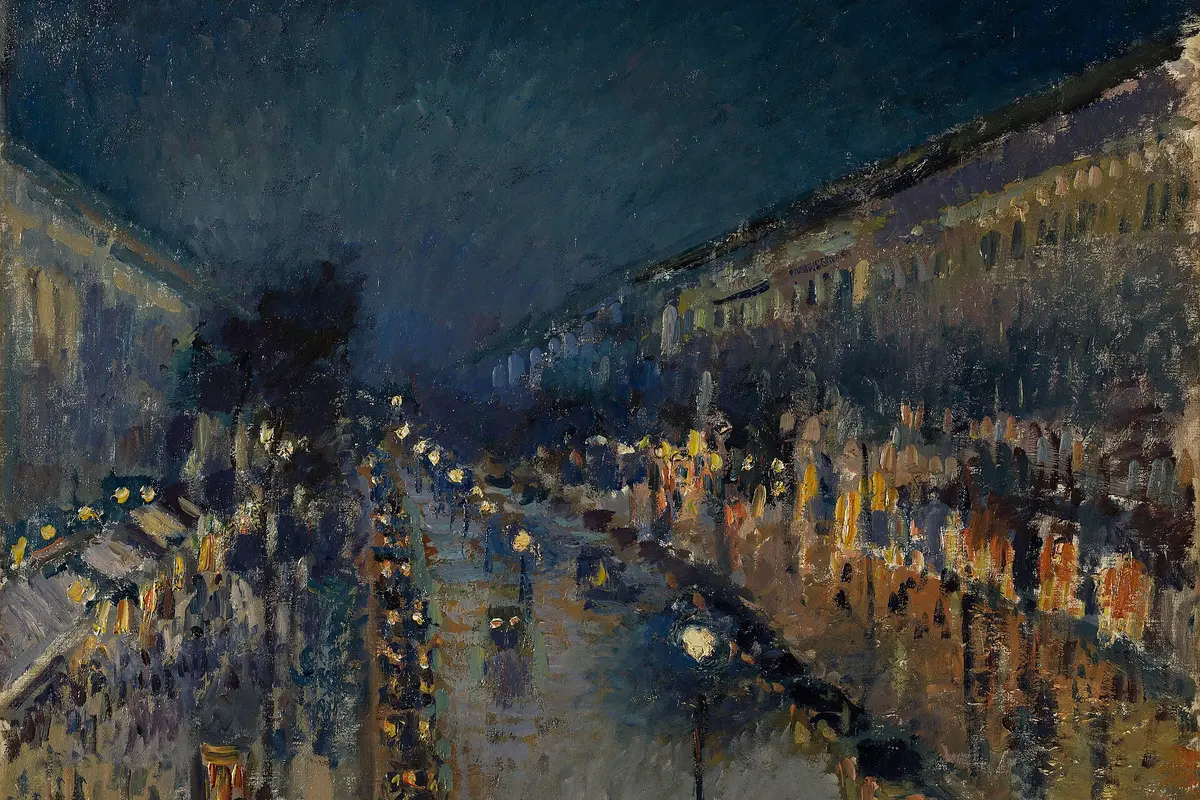
The neighbouring boulevards gave their name to a style of theatre. French Wikipedia says théâtre de boulevard grew out of the boulevards of old Paris, with bourgeois and popular theatres settling on Boulevard du Temple from the later decades of the 1700s, and that from the Second Empire onward they staged vaudevilles and comedies of intrigue. Boulevard Montmartre, next to Boulevard Poissonnière, was painted by Camille Pissarro in 1897, from his room at the Grand Hôtel de Russie, in a series of 14 works, one of them a night view. Wikipedia says the night version is held by the National Gallery.
What to notice when you walk it
Look up at the facades, which Wikipedia's lists suggest span cafés, cinemas and a theatre, and look at the street width, which French Wikipedia says was fixed at 35 metres in 1826. Notice how many ground floors have been cinemas or music halls in their day. The booking page says the show is at 24 Boulevard Poissonnière, in the 9th arrondissement, so the confirmation e-mail is the one to follow for exact directions on the night. No distances or walking times are quoted here, because the sources do not give them.
Frequently asked questions
How long is Boulevard Poissonnière?
French Wikipedia gives 351 metres, between Boulevard de Bonne-Nouvelle and Boulevard Montmartre.
What is near the theatre?
Le Grand Rex is at number 1, and the Max Linder Panorama cinema stands beside the Théâtre des Nouveautés at number 24, according to French Wikipedia.
Sources
- French Wikipedia: Boulevard Poissonnière
- English Wikipedia: Grands Boulevards
- English Wikipedia: Le Grand Rex
- French Wikipedia: Théâtre des Nouveautés
- French Wikipedia: Théâtre de boulevard
- English Wikipedia: Boulevard Montmartre, Spring (Pissarro's 1897 series)
- The booking page for How to Become a Parisian, on GetYourGuide